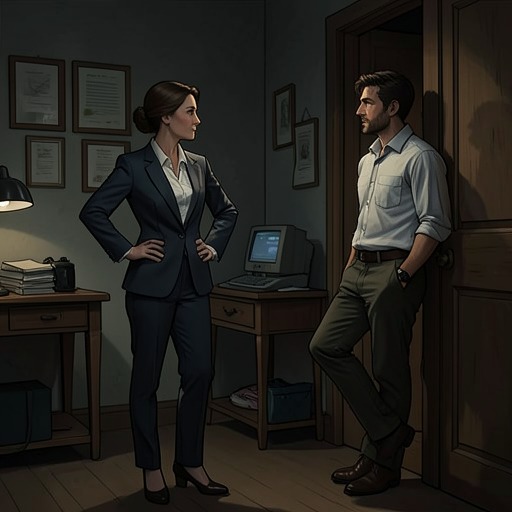
Hélène and Malek Bouali Discuss the Missing Motorcycle
And Their Children After ThemHélène and Malek Bouali Discuss the Missing Motorcycle is a confrontation shaped by two kinds of uncertainty: whether a family can recover a missing motorcycle by appealing to another family, and whether the adults involved can keep the dispute from becoming a more dangerous conflict. Hélène arrives believing that a conversation between parents may solve the problem; Anthony expects nothing to come of it. Their visit ends with a promise, a handshake, and an appearance of civility, but Malek’s actions after they leave reveal how little that outward agreement settles.
Hélène’s Decision and the Journey
On Thursday morning, after Anthony has finally told her the whole story in detail, Hélène turns the situation over in her mind and decides to act. She goes to her son’s bedroom, opens the window and shutters, and sits on the edge of his bed. The family’s future, she feels, depends on what she says next. Her plan is direct: she will go to the other boy’s house and speak both to his father and to the boy, trusting that they can work things out.
Anthony calls the plan crazy and tries to dissuade her, but her decision holds. By the time she leaves for work, dressed in high heels and blue eye shadow, her worry has almost disappeared. Confidence in the decision does not mean she approaches the visit casually. She fetches Anthony in the early afternoon, as agreed, and he remains silent in the car, still convinced that talking to the Boualis is pointless. Hélène insists that the adults can discuss matters and settle them. Near the ZUP Residential District, she avoids parking beside the towers; mother and son cover the last stretch on foot.
The setting complicates her hope of an ordinary parental conversation. The Boualis live in a relatively small housing project: fewer than a dozen low buildings arranged, from above, like the five pips on a die, alongside three fifteen-story towers, including Manet tower. Built during the Trente Glorieuses, the estate has been losing tenants. Those who remain have sometimes expanded into vacated apartments, while the housing authority ignores the unofficial changes and leaves rents unchanged. On the towers, satellite dishes and clotheslines stand against peeling stucco, rusting balconies, and stained facades. This is the address where Hélène means to turn a dispute into a face-to-face negotiation.
A Difficult Entrance
Just after three, they cross a street where children play on spring-mounted pandas and tired mothers watch from benches, some rocking strollers. The women see a tall brunette in platform shoes and a boy with a backpack; the pair look like thieves to them. Inside the building, the concrete is cool, and the stairwell is silent enough that their soles squeak unpleasantly as they climb. On the third floor they check the names beneath the doorbells and find the Boualis’ apartment.
The encounter at the door does not begin as Hélène had imagined. After a brief exchange, she blocks Malek’s attempt to close the door with her palm and shoulder, insisting that she must speak to him. He says he does not want to be bothered. When neighbors come down the stairs with a dog, their voices and the animal’s noise give Anthony the opening to push the door wider and pull his mother inside. He locks it behind them. In the narrow hallway, the three are pressed together; the neighbors pass downstairs, chatting in Arabic. Anthony, increasingly desperate to use the bathroom, asks Malek where it is. The mundane request disarms their host and gives Hélène a moment alone with him.
Malek is a small, mustached man dressed in denim. In the hallway’s yellow light, the narration emphasizes his large head and hands, deeply lined face, and weakly glinting eyes. He watches the visitors with mild curiosity rather than open anger. When Hélène asks after Hacine, Malek says his son is not there. Hélène says she would rather discuss the matter with Hacine present, but Malek repeats that he is absent and starts to shut the door. Her refusal to leave and Anthony’s forceful intervention carry them past the threshold, yet neither makes the meeting feel secure: inside, they are still guests who have entered against their host’s wishes.
The Conversation and Its Unequal Histories
While Anthony is away in the bathroom, Hélène tells Malek everything. She has rehearsed the account and delivers it smoothly, choosing what to emphasize. She uses the word thief twice, but gently, in a consoling tone. As he listens, Malek’s expression changes; he feels responsible and terribly old. The exchange is not simply a disagreement about a motorcycle. It brings the histories and vulnerabilities of two parents into the same room, though they do not interpret the situation alike.
Malek rejects Hélène’s view of Hacine, saying that she is mistaken and that his son is not like that. The narrator makes the limits of this defense plain: Malek is not lying, but neither is he especially interested in the truth; he is performing the task of a father, and intends to do so with Hacine later. Hélène lays out the facts again. Malek asks where the motorcycle is and says he has none there; Hélène admits that she does not know. She reiterates that she wants to speak to his son and says she will not leave without the motorcycle. Malek orders her to leave immediately. Their polite visit has reached its bluntest point, with each parent defending a child and neither able to produce the object at the center of the dispute.
The narration sets this small domestic standoff against Malek’s long experience at the steel mill. He and Rania emigrated from a poor country and found a kind of refuge in Heillange. For forty years Malek took orders, arriving punctually and making himself appear docile, while also being marked as Arab. He understood that advancement depended on more than ability, seniority, or qualifications. Black and North African workers occupied the lowest tier; Poles, Yugoslavs, Italians, and the least competent French workers stood above them. Higher jobs, in effect, required being born in France. Even a foreign worker who became an apprentice or journeyman remained surrounded by suspicion.
The mill’s hierarchy is described not as a neutral division of labor but as a system reinforced by inherited coercion, tacit rules, and institutional violence. Open contempt for Malek and other North African workers could become less explicit over time without disappearing. Against that history, Hélène’s appeal to a fellow parent meets a man whose sense of responsibility is entangled with humiliation and accumulated anger. Their disagreement cannot be separated from the unequal world in which Malek has spent his working life.
A Promise, a Handshake, and What Follows
The conversation continues over tea, served in small golden glasses that leave rings on the oilcloth. Malek says that Hélène has come into his home and insulted him. She replies that matters have already gone beyond that point. Anthony, restless beneath the table, imagines what might happen if Malek tries anything; he has often rehearsed settling scores and throwing punches in his mind. But Malek closes his eyes rather than provoking the fight Anthony anticipates.
The standoff shifts when Malek says that he will speak to Hacine when his son comes home and that, if Hacine took the motorcycle, he will return it. Hélène decides to believe him and briefly feels tenderness for this decent, humiliated old man. Malek adds that she can trust him. He clears the three glasses into the sink and gestures toward the exit. At the front door they shake hands, each observing the exact distance required by protocol. The courtesy closes the visit without resolving whether the motorcycle will be found or returned.
Once alone, Malek leans against the wall. His lips tremble and his legs feel as if they are failing; he bites down hard on his hand and drools. Later he goes to the basement storage area, where there are suitcases and tools but no motorcycle. He handles several tools in turn, judging how each sits in his grip, and chooses a pickax. He wedges it against the wall and saws off the handle just below its head, then takes the shortened handle upstairs and watches the Olympics. The measured farewell at the door is thus followed by an intensely physical, private preparation. The visit has produced a promise, not assurance: its apparent settlement leaves the central object missing and the threat of violence unresolved.